A priest in a small temple in Nashik recently noticed something odd – the silver plate used for aarti was developing a dull, greasy film that no amount of cleaning seemed to fully remove. The culprit, it turned out, wasn’t dust or age. It was the camphor being used every day.
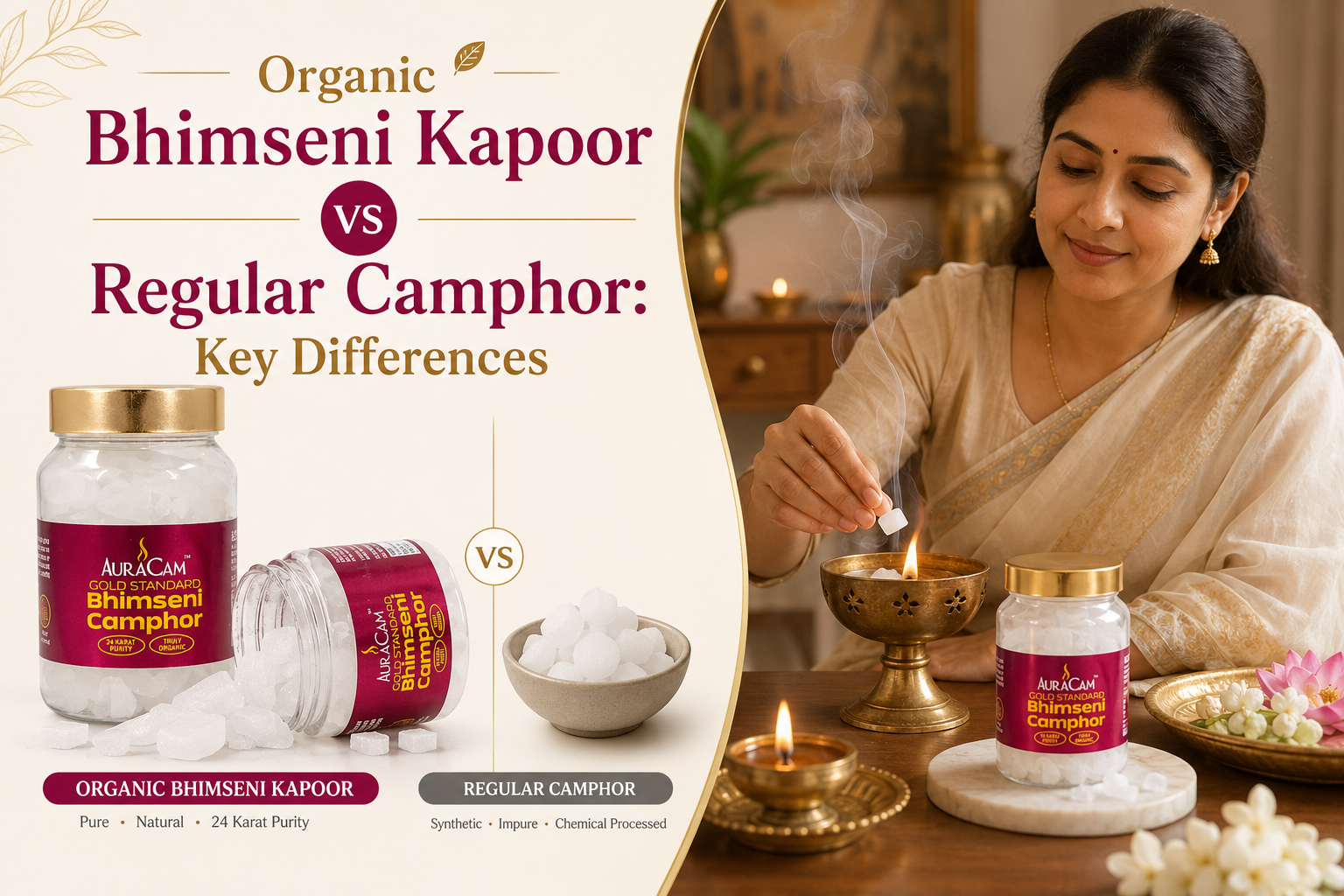
This is a more common story than most people realise. Organic Bhimseni kapoor and regular camphor are often treated as the same product with different names, but they behave very differently once lit – and that difference can show up on idols, vessels, and altar surfaces over time. Auracam’s natural Bhimseni camphor range exists precisely because this distinction matters more than most buyers realise.
This article walks through what actually separates organic Bhimseni kapoor from regular camphor – not just in marketing language, but in how each one burns, what it leaves behind, and why that matters for households and temples alike.
What is organic Bhimseni kapoor, and how is it different from regular camphor?
Organic Bhimseni kapoor is a natural form of camphor derived directly from the wood and resin of the camphor tree (Cinnamomum camphora), extracted through natural distillation rather than chemical synthesis. Regular camphor, by contrast, is most often manufactured synthetically from turpentine oil through a multi-step industrial process.
Organic Bhimseni kapoor and synthetic camphor share the same basic chemical formula, but their origins, purity levels, and traditional significance create meaningful differences that matter to anyone using camphor for rituals, wellness, or daily household purposes. The camphor industry in India distinguishes between synthetic varieties used widely in industrial and pharmaceutical applications and Bhimseni (natural) varieties that meet high-purity standards for smokeless burning and ritual use.
Organic Bhimseni kapoor has historically been considered the gold standard in Ayurveda and spiritual practice – valued not just for fragrance, but for the way it burns and what it leaves behind.
How does organic Bhimseni kapoor burn differently from regular camphor?
Organic Bhimseni kapoor burns in a way that’s immediately noticeable to anyone familiar with daily aarti. Pure Bhimseni camphor sublimates almost completely, turning directly from solid to vapour with little to no visible smoke and virtually no residue left behind.
Regular camphor, especially lower-purity synthetic variants, often produces black soot, a sharper smoke, and a whitish, greasy residue after burning. This residue isn’t just a cleaning inconvenience – over time, it can discolour idols, photo frames, and decorative brass or silver items kept on the altar.
Organic Bhimseni kapoor avoids this almost entirely, which is one reason it’s specifically sought after by temples managing valuable idols and ritual items. A clean, complete burn is traditionally considered a marker of “Shuddha” or pure camphor in ritual practice.
Why does purity matter so much when choosing organic Bhimseni kapoor?
Organic Bhimseni kapoor is defined largely by its purity – and this is also where the Indian camphor market faces one of its biggest challenges. Adulteration remains widespread, with products sometimes labelled “natural” or “Bhimseni” despite containing significant synthetic content.
Research comparing natural and synthetic camphor has found that authentic Bhimseni camphor contains higher concentrations of cineole and terpenoids – compounds linked to antimicrobial and anti-inflammatory properties – while synthetic variants score significantly lower on these measures. Genuine organic Bhimseni kapoor is generally expected to contain a minimum of 95–96% natural camphor content, verified through lab testing.
Organic Bhimseni kapoor without this level of verified purity isn’t really Bhimseni camphor at all – it’s regular camphor wearing a premium label. This is precisely why sourcing and testing matter as much as the final product itself.
How does Auracam ensure premium quality in its organic Bhimseni kapoor?
Organic Bhimseni kapoor from Auracam is built around a simple principle: the label should match what’s inside. At Auracam, we craft our camphor from camphor tree resin, with no synthetic additives, fillers, or artificial fragrance enhancers added at any stage.
Auracam’s authentic Bhimseni camphor ensures every product meets strict standards, including:
- Third-party lab purity testing, verifying a minimum of 95% natural camphor content per batch
- Sourcing raw camphor crystals directly linked to camphor tree extraction
- Burn-quality checks to confirm minimal smoke and residue
- Moisture-resistant packaging to preserve fragrance and prevent degradation
According to Auracam’s 2026 India market insights, this level of verification is becoming a key differentiator for buyers – particularly temple purchasing managers and premium retailers who have experienced quality inconsistencies with unbranded camphor in the past.
What do Indian consumers and temples prefer in 2026 - organic Bhimseni kapoor or regular camphor?
Organic Bhimseni kapoor is seeing a clear surge in preference across both urban and semi-urban India. India’s aromatic and spiritual products market is projected to cross ₹18,500 crore by 2027, growing at a CAGR of 11.4%, with natural camphor demand alone surging by over 34% in urban and semi-urban markets in recent years.
Organic Bhimseni kapoor is particularly favoured by temples for practical reasons: a large majority of temple purchasing managers surveyed have acknowledged the residue and discolouration problems associated with synthetic camphor on idols and ritual items. For institutions managing valuable idols and vessels, this isn’t a minor preference – it’s an operational consideration.
Organic Bhimseni kapoor is also gaining ground among urban households that have shifted from price-first purchasing toward quality-and-purity-first decisions, especially for products used daily in home temples.
How do the costs of organic Bhimseni kapoor and regular camphor compare in 2026?
Organic Bhimseni kapoor does carry a price premium over regular synthetic camphor – and this reflects genuine differences in sourcing, processing, and testing, not just branding.
Typical 2026 Indian market pricing comparison:
- Regular synthetic camphor (100g): approximately ₹100–₹150
- Organic Bhimseni kapoor, standard household pack (100g): approximately ₹220–₹280
- Organic Bhimseni kapoor, premium temple pack (250g): approximately ₹500–₹650
- Organic Bhimseni kapoor, bulk packs for temples/retailers (500g): approximately ₹950–₹1,200
- Organic Bhimseni kapoor, wholesale rates (1kg and above): starting around ₹1,800–₹2,200 per kg, depending on order volume
For households that burn camphor daily, the difference often works out to just a few extra rupees per use – a small cost for verified purity, cleaner burning, and consistent ritual quality. Temples and premium retailers can contact Auracam directly for bulk pricing tailored to institutional needs.
What role does eco-friendly sourcing play in organic Bhimseni kapoor production?
Organic Bhimseni kapoor production aligns naturally with India’s growing eco-conscious consumer trends. Because it’s derived from natural plant resin rather than petrochemical inputs, natural camphor is fully biodegradable and breaks down without contaminating soil or water.
Organic Bhimseni kapoor production is also relevant to India’s broader sustainability goals – natural camphor is recognised under low-concern substance classifications for chemical safety, making it easier to position as a genuinely eco-friendly product compared to synthetic alternatives derived from turpentine processing.
Organic Bhimseni kapoor from Auracam reflects this commitment through responsible sourcing practices and packaging designed to minimise waste – an increasingly important factor for premium retailers and environmentally conscious consumers alike.
People Also Ask: Quick Answers on Organic Bhimseni Kapoor
Will switching to organic Bhimseni kapoor change how my puja smells?
Yes, slightly – most people notice a softer, milder fragrance compared to synthetic camphor, which can have a sharper, more chemical edge.
Can synthetic camphor damage idols or puja items over time?
Yes, repeated use of low-purity synthetic camphor can leave a greasy residue that gradually discolours brass, silver, and idol finishes.
Is “natural” on a camphor label always accurate?
Not always – without third-party purity testing, a “natural” label doesn’t guarantee the product is genuinely Bhimseni camphor.
Does organic Bhimseni kapoor work the same way in humid or coastal climates?
Yes, though like all camphor, it should be stored in airtight packaging to prevent it from evaporating faster in humid conditions.
Is organic Bhimseni kapoor recommended for people with breathing sensitivities? Many users with mild respiratory sensitivity find natural camphor gentler than synthetic variants, though anyone with specific health conditions should consult a doctor before regular use.
Final Thoughts: Choosing What Goes on Your Altar
The choice between organic Bhimseni kapoor and regular camphor isn’t really about price – it’s about what you’re comfortable lighting in your home, near your family, and in front of your deities every single day. One is a natural product with centuries of tradition behind it; the other is a chemical substitute that happens to look the same.
As India’s wellness and clean-living movements continue to grow through 2026, more households and temples are making that distinction consciously. With Auracam’s authentic Bhimseni camphor, you’re choosing a product that’s been verified for purity at every stage – camphor that’s pure enough to honour the tradition it’s part of.
Frequently Asked Questions
- How do I know if the camphor I’m currently using is genuine Bhimseni camphor?
Check the burn – genuine Bhimseni camphor leaves little to no residue, while synthetic camphor often leaves soot or a greasy film, and look for brands that disclose purity testing results. - Can I mix organic Bhimseni kapoor with leftover regular camphor at home?
It’s better not to, since mixing can affect both the burn quality and fragrance consistency – it’s best to finish one type before switching to the other. - Does organic Bhimseni kapoor have a longer shelf life than regular camphor?
Shelf life depends more on packaging and storage than on type – both should be kept in airtight containers, though natural camphor can evaporate slightly faster if exposed to air. - Why do some temples specifically request Bhimseni camphor for special occasions?
Major festivals and ceremonies often involve larger quantities of camphor and more valuable ritual items, making the residue-free burn of Bhimseni camphor especially important. - Is there a noticeable difference in smoke levels between the two types?
Yes, organic Bhimseni kapoor typically produces less visible smoke, which many users find more comfortable in smaller, enclosed puja spaces. - What’s the easiest way to start switching to organic Bhimseni kapoor?
Many households start by using it for daily aarti while keeping regular camphor for occasional non-ritual uses, gradually transitioning as they notice the difference in quality.